Advanced Materials Characterization Services: Unlocking Innovation with Precision Analysis
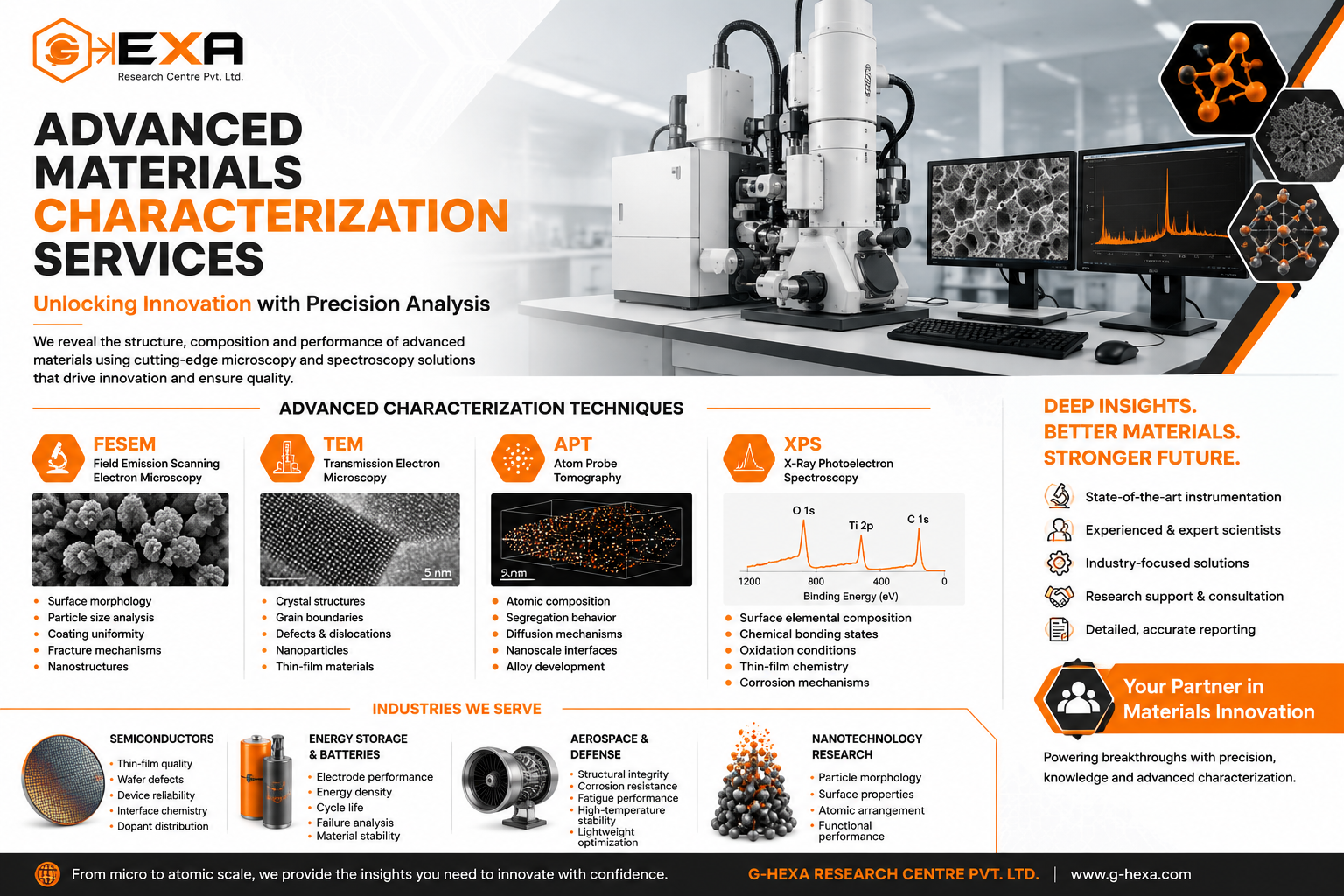
Modern research and product development rely heavily on understanding materials at the micro and nanoscale. Whether developing advanced semiconductors, high-performance batteries, nanomaterials, coatings, polymers, or aerospace components, precise characterization is essential for ensuring quality, performance, and innovation.
At G-Hexa Research Centre, scientists and engineers leverage advanced analytical techniques to reveal critical information about material structure, composition, defects, and performance. Through cutting-edge characterization solutions, industries and research institutions can accelerate innovation while minimizing development risks.
Why Materials Characterization Matters
Every material possesses unique physical, chemical, and structural properties that determine its performance. Without accurate characterization, manufacturers and researchers may face challenges such as:
- Product failures
- Reduced efficiency
- Inconsistent quality
- Shorter lifecycle performance
- Increased development costs
Advanced characterization helps identify defects, contamination, grain structures, elemental distribution, surface chemistry, and atomic-scale behavior before these issues impact real-world applications.
For organizations seeking comprehensive analytical support, materials characterization services provide critical insights that drive innovation and quality assurance.
Advanced Characterization Techniques Used in Modern Research
Field Emission Scanning Electron Microscopy (FESEM)
FESEM enables ultra-high-resolution imaging of material surfaces. Researchers use FESEM to study:
- Surface morphology
- Particle size analysis
- Coating uniformity
- Fracture mechanisms
- Nanostructures
Through advanced FESEM analysis services, scientists can visualize structures at the nanoscale and identify manufacturing defects with remarkable precision.
Transmission Electron Microscopy (TEM)
TEM provides internal structural information at extremely high magnifications, enabling researchers to investigate:
- Crystal structures
- Grain boundaries
- Defects and dislocations
- Nanoparticles
- Thin-film materials
Organizations developing next-generation materials often rely on Transmission Electron Microscopy services to gain atomic-level insights into material performance.
Atom Probe Tomography (APT)
APT is among the most advanced characterization techniques available today. It provides three-dimensional atomic-scale mapping of materials.
APT helps researchers understand:
- Atomic composition
- Segregation behavior
- Diffusion mechanisms
- Nanoscale interfaces
- Alloy development
For researchers working on advanced alloys and semiconductor technologies, Atom Probe Tomography analysis offers unparalleled accuracy.
X-Ray Photoelectron Spectroscopy (XPS)
Surface chemistry plays a critical role in material performance. XPS enables detailed examination of:
- Surface elemental composition
- Chemical bonding states
- Oxidation conditions
- Thin-film chemistry
- Corrosion mechanisms
Researchers can achieve deeper insights into surface interactions through professional XPS characterization services.
Industries Benefiting from Advanced Materials Analysis
Semiconductor Industry
Semiconductor manufacturing demands nanometer-level precision. Characterization techniques help evaluate:
- Thin-film quality
- Wafer defects
- Device reliability
- Interface chemistry
- Dopant distribution
Advanced microscopy and spectroscopy play a crucial role in supporting modern semiconductor innovation.
Energy Storage and Batteries
Battery manufacturers use characterization to improve:
- Electrode performance
- Energy density
- Cycle life
- Failure analysis
- Material stability
Detailed analytical studies accelerate the development of safer and more efficient energy storage systems.
Aerospace and Defense
Aerospace materials must withstand extreme environments. Characterization helps ensure:
- Structural integrity
- Corrosion resistance
- Fatigue performance
- High-temperature stability
- Lightweight material optimization
Nanotechnology Research
Nanomaterials require specialized analytical techniques to understand:
- Particle morphology
- Surface properties
- Atomic arrangement
- Functional performance
Researchers depend on sophisticated characterization tools to unlock the full potential of nanotechnology.
Choosing the Right Materials Characterization Partner
Selecting a reliable analytical partner is critical for obtaining accurate, reproducible, and actionable results. Consider factors such as:
- Advanced instrumentation
- Experienced scientists
- Industry expertise
- Research support capabilities
- Detailed reporting standards
Organizations seeking comprehensive analytical support can benefit from partnering with G-Hexa Research Centre, which provides advanced microscopy, spectroscopy, and materials characterization solutions for research institutions, startups, and industrial manufacturers.
The Future of Materials Characterization
As industries move toward smaller devices, smarter materials, and more complex manufacturing processes, advanced characterization will become even more important. Emerging technologies such as quantum materials, next-generation semiconductors, solid-state batteries, and nanotechnology innovations require deeper insights at the atomic level.
By leveraging sophisticated analytical techniques, researchers can accelerate discoveries, improve product performance, and reduce development cycles.
Materials characterization forms the foundation of scientific innovation and industrial advancement. From FESEM and TEM to APT and XPS, modern analytical techniques provide the critical insights needed to understand materials at unprecedented levels of detail.
Whether you’re developing advanced materials, optimizing manufacturing processes, or conducting groundbreaking research, partnering with an experienced characterization laboratory can significantly enhance outcomes and accelerate innovation.