
Your Cart
Add ₹300.00 to cart and get free shipping!
No products in the cart.
Free Shipping on All Orders Over $750
Add ₹300.00 to cart and get free shipping!
No products in the cart.
Free Shipping on All Orders Over $750
Crystallographic Orientation & Grain Structure Intelligence
Electron Backscatter Diffraction (EBSD) Analysis
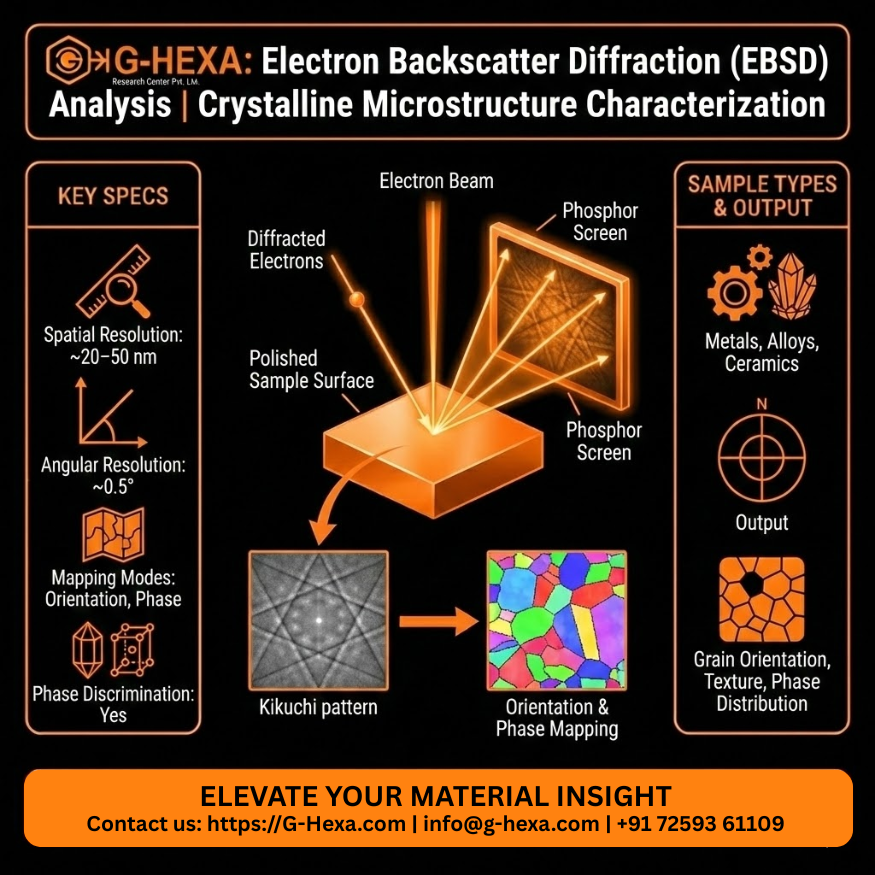
From Crystal Orientation to Mechanical Performance
Mechanical strength, corrosion resistance, fatigue life, and anisotropic behavior are governed by crystallographic architecture. Grain orientation, misorientation angles, and boundary character distribution determine how materials respond under stress, heat, and environmental exposure.
At G-Hexa, EBSD is not merely pattern indexing — it is a structural intelligence tool that reveals:
Grain size and morphology
Texture evolution
Recrystallization behavior
Deformation mechanisms
Phase identification and distribution
By correlating EBSD maps with manufacturing parameters, we translate crystallography into process optimization.
ADVANCED EBSD CAPABILITIES
Orientation Mapping
Grain Size & Boundary Analysis
Texture Analysis
Phase Identification
Strain & Deformation Mapping
Recrystallization Studies
Expert Sample Preparation Workflow
- Sectioning and mounting with orientation preservation
- Sequential grinding and fine polishing
- Final chemo-mechanical polishing (e.g., colloidal silica)
- Surface deformation layer removal
- Conductive coating optimization (if required)
- Calibration of tilt geometry and detector alignment
Challenges in EBSD Analysis
EBSD is highly sensitive to surface damage, contamination, and preparation-induced deformation. Improper polishing can degrade pattern clarity and misrepresent grain boundaries.
Our expertise ensures:
High indexing rates with minimal noise
Accurate boundary angle classification
Reliable phase discrimination in complex alloys
Distinction between true strain and preparation artifacts
Diffraction patterns are interpreted structurally — not just visually.
MANUFACTURING–MICROSTRUCTURE CORRELATION
| Material Domain | EBSD Insight | Optimization Impact |
|---|---|---|
| Steel & Alloys | Grain size & recrystallization behavior | Heat-treatment cycle optimization |
| Aerospace Metals | Texture & boundary distribution | Fatigue life enhancement |
| Automotive Components | Deformation mapping in gears & shafts | Process parameter refinement |
| Additive Manufacturing | Solidification texture & anisotropy | Mechanical property consistency |
| Electronic Materials | Phase distribution & orientation control | Performance stability |
TRAINED INTERPRETATION, STRUCTURAL DECISION-MAKING
Failure Origin Analysis
Texture–Property Correlation
FROM FAILURE INVESTIGATION TO ALLOY DESIGN
EBSD analysis supports both diagnostic and developmental objectives:
Fatigue crack origin identification
Heat-treatment validation
Welding microstructure evaluation
Additive manufacturing texture analysis
Grain refinement strategy development
Each orientation map contributes to smarter metallurgical engineering.
CRYSTAL STRUCTURE AS PERFORMANCE BLUEPRINT
EBSD is more than diffraction indexing. It is the decoding of structural symmetry, grain evolution, and deformation pathways. Through disciplined crystallographic analysis and industrial correlation, we convert microstructure into predictive material performance.
