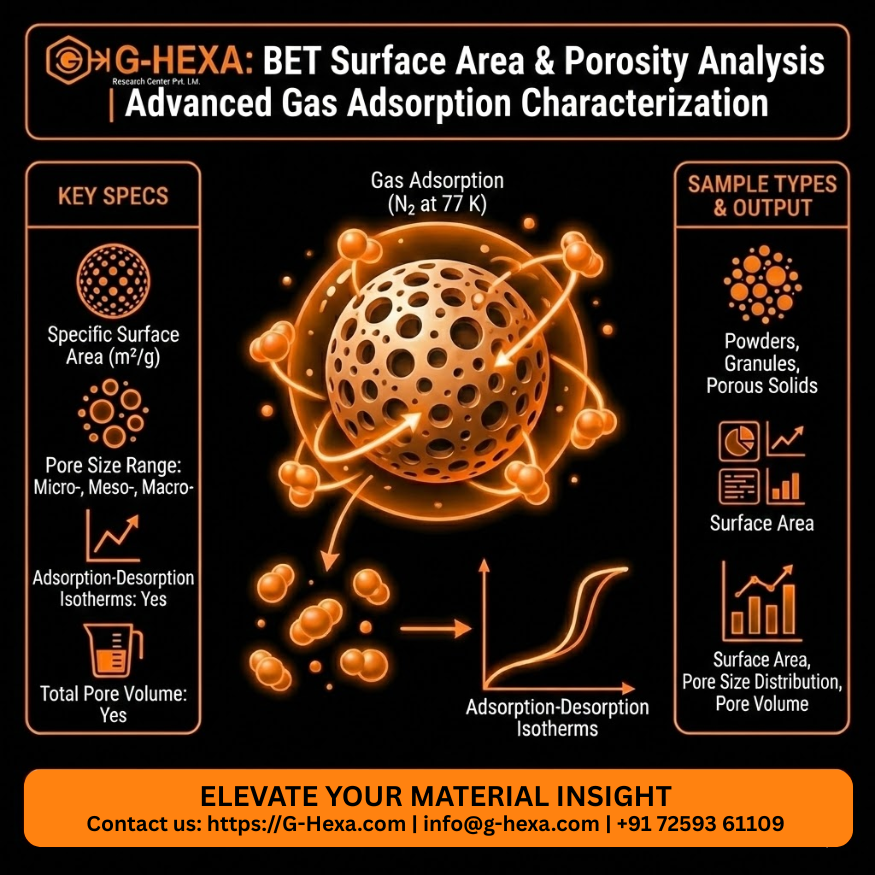
Where performance depends on surface reactivity and pore structure, G-Hexa quantifies the unseen architecture within materials. Through Brunauer–Emmett–Teller (BET) adsorption analysis and advanced porosity modeling, we reveal surface area, pore size distribution, and adsorption behavior critical to catalysts, battery materials, pharmaceuticals, ceramics, and advanced composites.
Translating Surface Physics into Functional Performance
In porous and high-surface-area materials, functionality is governed not only by composition — but by accessible surface and internal pore geometry.
Catalytic efficiency, adsorption capacity, electrochemical activity, filtration performance, and mechanical integrity are all controlled by:
Specific surface area
Micro/meso/macropore distribution
Pore volume
Surface accessibility
Gas adsorption kinetics
At G-Hexa, BET analysis is not just a numerical output. It is a structural fingerprint that connects nano-scale architecture with industrial performance.
ADVANCED BET & POROSITY CAPABILITIES
High-precision gas adsorption systems with automated degassing, multi-point BET modeling, and pore distribution analysis for reliable and reproducible characterization.
Surface Area Measurement
Accurate specific surface area (m²/g) via multi-point BET adsorption.
Pore Size Distribution
BJH, DFT, and t-plot methods for micro- and mesopore analysis.
Total Pore Volume
Quantification of accessible pore capacity.
Micropore Analysis
Sub-nanometer pore characterization for advanced catalysts and carbons.
Controlled Degassing
Pre-treatment optimization to eliminate adsorbed contaminants without structural damage.
Multi-Gas Capability
Nitrogen, argon, CO₂ adsorption for tailored material evaluation.
Expert Sample Preparation Workflow
Reliable BET analysis begins with controlled sample conditioning and degassing protocols that preserve true pore structure.
Sample drying and moisture removal
Controlled thermal degassing under vacuum or inert gas
Degassing temperature optimization to prevent pore collapse
Sample mass calibration for adsorption accuracy
Leak testing and system stabilization
Replicate measurement validation
Every sample is prepared to ensure adsorption reflects intrinsic structure — not preparation artifacts.
Challenges in Surface Area & Porosity Analysis
Incorrect degassing can alter pore geometry. High-temperature pretreatment may collapse delicate frameworks. Residual solvents or moisture can distort adsorption isotherms.
Our expertise ensures:
Accurate separation of micropore and mesopore contributions