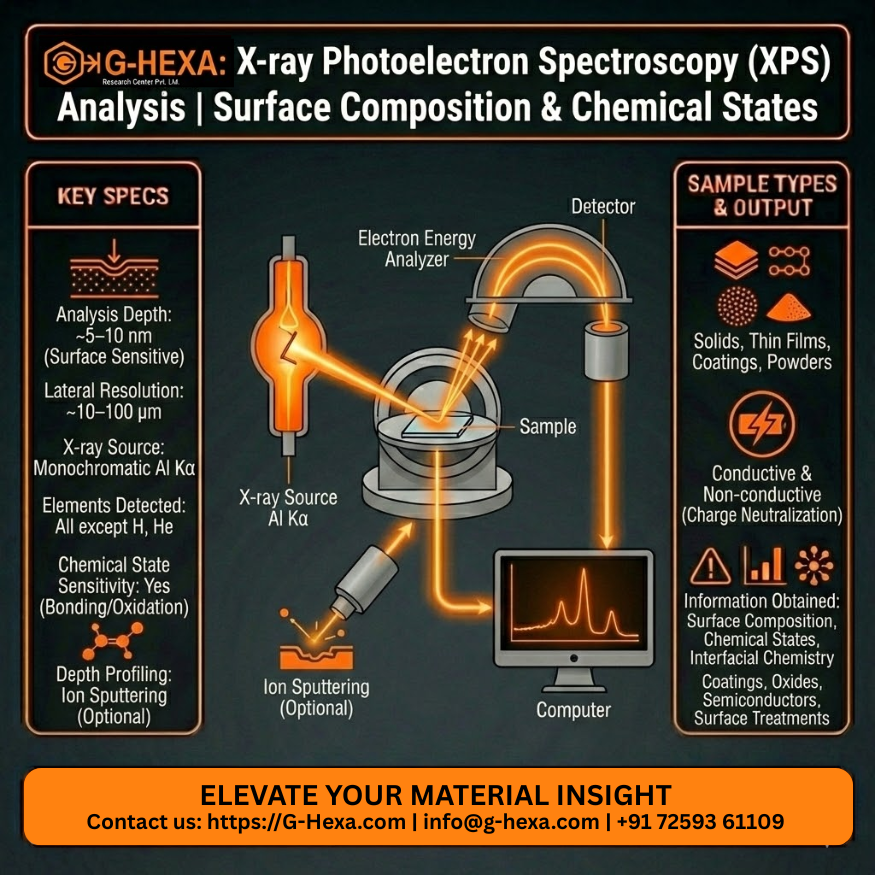
Where surface chemistry governs adhesion, corrosion resistance, catalytic activity, and electronic performance, G-Hexa decodes elemental composition and chemical states through high-resolution XPS analysis. By measuring photoelectron binding energies, we reveal surface elemental distribution, oxidation states, and thin-film chemistry — transforming surface data into actionable engineering insight.
Material performance is often controlled by the outermost atomic layers — typically the top 1–10 nanometers. XPS provides quantitative elemental composition and chemical state information within this critical surface region.
At G-Hexa, XPS enables:
Elemental identification (except H and He)
Oxidation state analysis
Thin film chemistry evaluation
Surface contamination detection
Coating interface investigation
By correlating binding energy shifts with chemical environments, we bridge surface science with product reliability.
Advanced XPS Capabilities
High-resolution monochromatic XPS systems with precise charge compensation and depth profiling functionality for accurate surface characterization.
Chemical state and oxidation state differentiation.
Quantitative Surface Composition
Atomic percentage calculation with sensitivity factor correction.
Depth Profiling (Ion Sputtering)
Layer-by-layer compositional analysis of thin films and coatings.
Chemical State Deconvolution
Peak fitting for complex multiphase or oxidized systems.
Angle-Resolved XPS
Non-destructive depth-sensitive surface analysis.
Expert Sample Preparation Workflow
Accurate XPS results require contamination-free surfaces and controlled handling to preserve true surface chemistry.
Cleanroom-level handling and storage
Surface cleaning (if appropriate) without altering chemistry
Mounting with electrical grounding
Charge neutralization setup for insulating samples
Calibration using reference standards (e.g., C 1s peak alignment)
Repeat measurement validation
Each sample is analyzed under ultra-high vacuum conditions to ensure surface integrity.
Challenges in XPS Analysis
Surface contamination, charging effects in non-conductive materials, and peak overlap can complicate interpretation. Improper sputtering may alter chemical states during depth profiling.
Our expertise ensures:
Accurate peak fitting and chemical state assignment
Reliable separation of overlapping elemental peaks
Correct interpretation of oxidation states
Controlled sputtering to preserve chemical authenticity
XPS spectra are interpreted chemically — not just numerically.
Manufacturing–Surface Correlation
Material Domain
XPS Insight
Optimization Impact
Coatings
Oxide thickness & bonding chemistry
Adhesion and durability improvement
Aerospace Alloys
Surface oxidation states
Corrosion resistance enhancement
Battery Materials
SEI layer chemistry
Electrochemical stability control
Semiconductor Devices
Thin-film composition
Electronic reliability improvement
Polymers
Surface functional groups
Improved coating or bonding compatibility
Trained Interpretation, Surface Certainty
When analyzed by experienced surface scientists, XPS data reveals subtle chemical variations that impact performance.
Oxidation State Determination
Differentiate metallic, oxidized, and complex chemical states.
Thin Film & Interface Analysis
Characterize multilayer systems and coating adhesion zones.
Contamination & Failure Diagnosis
Identify surface impurities causing adhesion or corrosion failure.
From Failure Analysis to Surface Engineering
XPS supports both diagnostic and developmental applications:
Corrosion product analysis
Adhesion failure investigation
Surface treatment validation
Thin-film deposition quality control
Catalyst surface chemistry evaluation
Each binding energy peak contributes to deeper chemical clarity.
SURFACE SCIENCE FOR INDUSTRIAL PRECISION
XPS is more than elemental detection — it is atomic-level surface intelligence. The outermost layers of a material often determine its long-term reliability.
Through disciplined chemical interpretation and industrial correlation, we convert nanometer-scale chemistry into macro-scale performance assurance.
“Performance begins at the surface — we measure it, decode it, and translate it into engineering confidence.”
Crystallographic Intelligence for Industrial Reliability
Tell us your surface chemistry challenge. We design a precise XPS strategy that transforms binding energy data into engineering control.