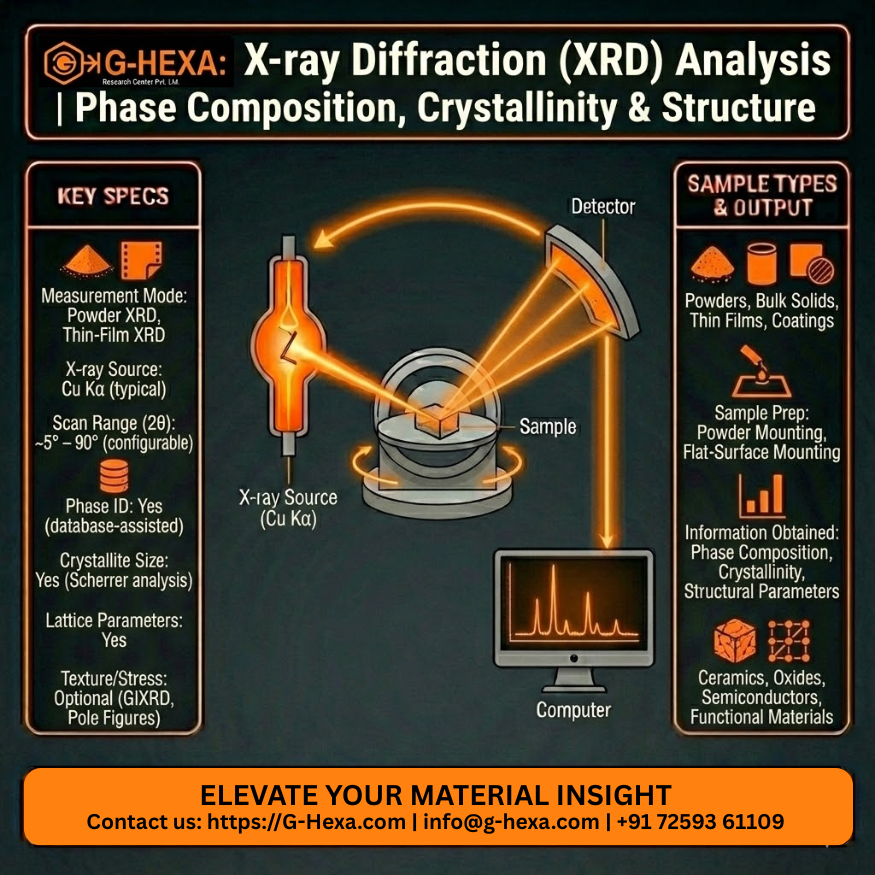
When X-rays interact with a crystalline material, they scatter according to atomic spacing. The resulting diffraction pattern is a structural fingerprint that reveals:
Phase composition
Crystal structure and symmetry
Degree of crystallinity
Lattice parameters
Residual stress and strain
At G-Hexa, XRD is not merely pattern matching — it is crystallographic interpretation that connects atomic arrangement with mechanical performance, thermal stability, corrosion resistance, and functional reliability.
By correlating diffraction data with processing conditions, we bridge structure with manufacturing control.
Advanced XRD Capabilities
High-resolution diffractometers with precise angular control, phase databases, and quantitative modeling tools for robust crystallographic analysis.
Phase Identification (Qualitative Analysis)
Database-matched diffraction patterns for accurate phase confirmation.
Quantitative Phase Analysis
Precise phase fraction determination in multiphase systems.
Crystallinity Assessment
Evaluation of amorphous vs. crystalline content.
Lattice Parameter Determination
Unit cell dimension calculation for alloy and compound studies.
Residual Stress Measurement
Sin²ψ method for stress and strain evaluation.
Texture & Preferred Orientation Analysis
Assessment of anisotropy in rolled or processed materials.
Expert Sample Preparation Workflow
Accurate diffraction results require optimized sample preparation to ensure representative and reproducible data.
Powder grinding for uniform particle size distribution
Randomized sample mounting to minimize preferred orientation
Thin film alignment and substrate correction
Surface smoothing for bulk samples
Calibration using standard reference materials
Repeated scans for validation and noise reduction
Each measurement is optimized to preserve true vibrational signatures.
Challenges in XRD Analysis
Preferred orientation, overlapping peaks, low crystallinity, and fluorescence effects can complicate interpretation. Complex multiphase alloys may require advanced refinement methods.
Our expertise ensures:
Accurate separation of overlapping diffraction peaks
Reliable identification of minor phases
Correct amorphous content estimation
Robust Rietveld modeling for quantitative analysis
Diffraction patterns are interpreted structurally — not just visually.
When analyzed by experienced material scientists, XRD data reveals structural transitions invisible to conventional microscopy.
Phase Transformation Monitoring
Track structural evolution during heat treatment or synthesis.
Residual Stress Evaluation
Quantify internal stress for reliability assessment.
Crystallinity Benchmarking
Compare production batches for quality assurance.
From Failure Analysis to Material Development
XRD supports both diagnostic and research objectives:
Phase failure identification in fractured components
Corrosion product analysis
Additive manufacturing phase validation
Cement hydration studies
New material development and benchmarking
Each diffraction profile contributes to structural clarity and performance optimization.
ATOMIC ORDER AS PERFORMANCE FOUNDATION
X-ray diffraction is more than peak analysis — it is the decoding of atomic order. Every peak position reflects lattice spacing; every intensity ratio reflects structural proportion.
Through disciplined crystallographic interpretation and industrial correlation, we convert atomic arrangement into process intelligence.
“Every diffraction peak marks atomic order — we translate it into engineering precision.”
Crystallographic Intelligence for Industrial Reliability
Tell us your structural challenge. We design a precise XRD strategy that transforms diffraction data into engineering confidence.