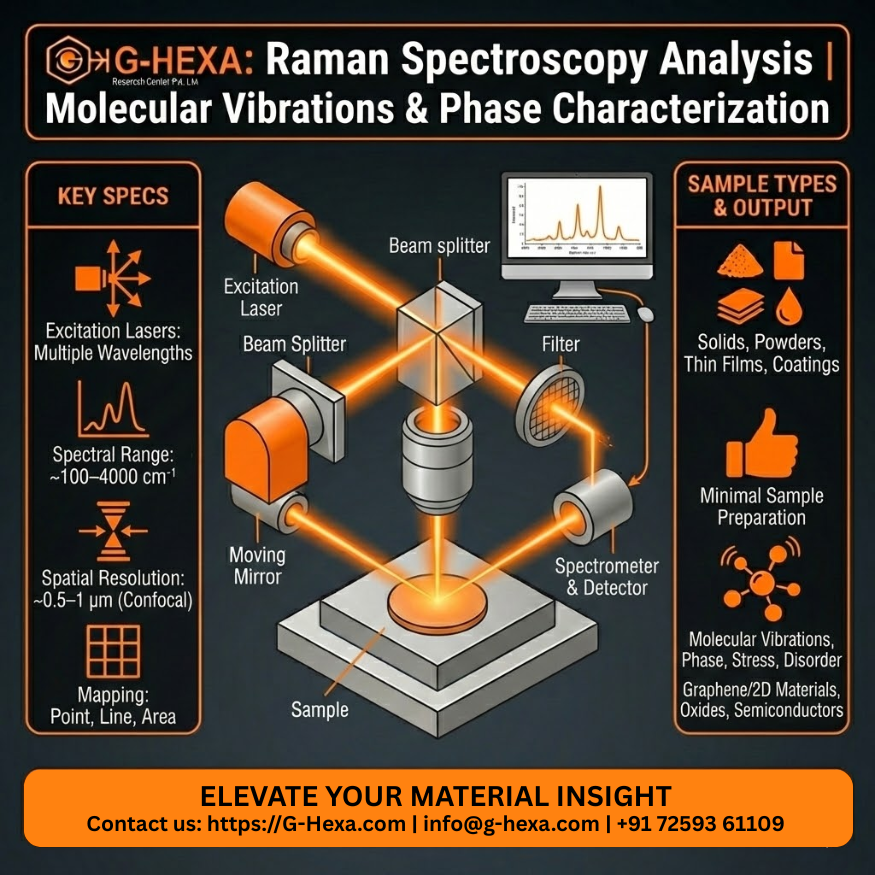
Where molecular structure, crystallinity, and phase composition determine performance, G-Hexa decodes vibrational fingerprints through high-resolution Raman spectroscopy. By analyzing inelastic light scattering, we identify materials, polymorphs, carbon structures, stress states, and chemical changes — transforming spectral shifts into structural intelligence.
Raman spectroscopy reveals how atoms vibrate within a material’s structure. These vibrational modes provide insight into molecular bonding, crystal symmetry, stress, disorder, and chemical transformations.
At G-Hexa, Raman analysis is not limited to peak identification — it enables:
By correlating Raman shifts with processing conditions, we connect laboratory spectra with real-world performance.
Advanced Raman Capabilities
High-sensitivity Raman systems with multiple excitation wavelengths, confocal optics, and micro-mapping capabilities for precise structural characterization.
Multi-Wavelength Excitation
Optimized laser selection (e.g., 532 nm, 633 nm, 785 nm) to minimize fluorescence and enhance signal clarity.
Micro-Raman Mapping
Spatially resolved chemical and phase mapping at micron-scale resolution.
Phase & Polymorph Identification
Distinguish crystalline forms in ceramics, pharmaceuticals, and minerals.
Carbon Structure Analysis
Graphite, graphene, CNTs, and amorphous carbon characterization via D/G ratio evaluation.
Stress & Strain Mapping
Raman peak shift analysis for residual stress and deformation studies.
In-Situ & Temperature Studies
Real-time monitoring of structural evolution under controlled conditions.
Expert Sample Preparation Workflow
Accurate Raman results require proper sample preparation to minimize fluorescence, surface contamination, and thermal damage.
Surface cleaning to remove contaminants
Selection of optimal excitation wavelength
Adjustment of laser power to prevent heating artifacts
Focusing and confocal optimization
Baseline correction and fluorescence suppression
Repeated spectral validation for reproducibility
Each measurement is optimized to preserve true vibrational signatures.
Challenges in Raman Analysis
Fluorescence interference, sample heating, and weak scattering signals can complicate interpretation. Overlapping peaks in multiphase materials require expert differentiation.
Our expertise ensures:
Accurate identification of polymorphic transitions
Reliable carbon structural assessment
Separation of fluorescence background from true peaks
Distinction between stress-induced shifts and compositional variation
Raman spectra are interpreted structurally — not just spectrally.
Manufacturing–Surface Correlation
Material Domain
Raman Insight
Optimization Impact
Battery Materials
Phase evolution & structural disorder
Enhanced electrochemical stability
Ceramics
Crystal phase identification
Improved sintering & strength control
Pharmaceuticals
Polymorph differentiation
Regulatory compliance & formulation stability
Carbon Materials
Degree of graphitization
Conductivity and durability enhancement
Semiconductor Materials
Stress mapping
Reliability and yield improvement
Trained Interpretation, Phase Intelligence
When analyzed by experienced spectroscopists, Raman data reveals subtle structural changes invisible to other techniques.
Phase Transition Monitoring
Detect structural transformation under thermal or mechanical stress.
Carbon Disorder Quantification
Evaluate crystallinity and defect density.
Reaction Pathway Tracking
Monitor chemical changes in real time.
From Failure Analysis to Material Development
Raman spectroscopy supports both diagnostic and R&D applications:
Stress-induced cracking investigation
Graphene and nanocarbon evaluation
Ceramic phase transformation studies
Polymorphic stability assessment
In-situ reaction monitoring
Each Raman spectrum contributes to structural clarity and innovation.
VIBRATIONAL INTELLIGENCE FOR INDUSTRY
Raman spectroscopy is more than a spectrum — it is a structural narrative written in vibrational energy. Every peak position, shift, and intensity variation carries information about symmetry, bonding, and internal stress.
Through disciplined spectral analysis and industrial correlation, we translate vibrational physics into engineering precision.
“Every vibrational mode reveals a structural truth — we decode it for performance certainty.”
Structural Clarity Through Vibrational Insight
Tell us your material challenge. We design a precise Raman analysis strategy that transforms vibrational data into engineering advantage.